
Last updated July 8, 2026
The Complete Guide to Garage Door in Orlando
Most garage door guides are written for homeowners in Ohio. Orlando averages 233 sunny days a year, a humidity level that corrodes hardware in 18 months, and sits inside Florida’s hurricane belt — none of that shows up in the advice most people find online. We’ve spent 14 years watching doors fail in Baldwin Park, Winter Park, and College Park for reasons that national articles never mention: UV-brittled vinyl seals, salt-air corrosion on coastal-facing hardware, and pre-2002 wind load doors that insurance companies now flag during renewal. This guide covers what actually matters for your garage door in Orlando — from material selection that survives our wet season to reading an estimate like someone who knows the local code.
Quick Answer
A garage door in Orlando needs to withstand 233 days of annual UV exposure, humidity-driven corrosion, and Florida Building Code wind load requirements of 120–150 mph depending on your zone. For most Orlando homeowners, that means a 24- or 25-gauge steel door with a composite or vinyl-backed insulation, hardware rated for coastal humidity, and annual preventive maintenance that includes spring tension checks and seal inspection — not just a quick lube-and-go.
Table of Contents
- How Orlando’s Climate Destroys Garage Doors Faster Than National Averages
- Garage Door Materials for Central Florida: What Survives vs. What Looks Good
- Florida Building Code Wind Load Requirements: Pre-2002 Doors and Your Insurance
- Tune-Up vs. Preventive Maintenance: What You’re Actually Paying For in Orlando
- How to Read a Garage Door Estimate in Orlando: Line Items, Red Flags, and Fair Pricing
- Garage Door Openers in Orlando: Power, Battery Backup, and Hurricane Prep
- Common Mistakes to Avoid
- When to Call a Professional
- Frequently Asked Questions
How Orlando’s Climate Destroys Garage Doors Faster Than National Averages
In Orlando, a garage door spring that the manufacturer rates for 10,000 cycles often fails at 7,000. We’ve tracked this across our jobs in Thornton Park, Audubon Park, and the Conway chain of lakes. The culprit isn’t defective steel — it’s thermal cycling plus humidity corrosion.
Here’s what happens in Central Florida that doesn’t happen in Cleveland:
- Spring fatigue accelerates. Our daily temperature swings of 20–25°F from morning to afternoon create more expansion-contraction cycles than stable northern climates. In Lake Nona and Meadow Woods, we regularly see torsion springs develop micro-fractures 30% earlier than their cycle rating suggests.
- Cable fraying starts at the drum. Humidity wicks into the cable winding around the torsion drum, creating corrosion at the bend point. We’ve replaced cables on 4-year-old doors in Kissimmee and St. Cloud that should have lasted 15 years.
- Bottom seals UV-degrade in 18–24 months. Standard vinyl seals in direct Orlando sun harden and crack faster than the 3–5 year lifespan you’ll see quoted nationally. In our experience, south-facing doors in Dr. Phillips and Windermere need seal replacement every 20 months on average.
- Track hardware corrodes from the inside out. Galvanized rollers and hinges look fine until the humidity has worked between layers. We find this most often in garage conversions near the Econlockhatchee River basin where groundwater humidity stays elevated year-round.
The fix isn’t buying “better” generic parts — it’s specifying hardware for the environment. We use zinc-aluminum coated springs and stainless steel cables on coastal-adjacent Orlando jobs, and we schedule preventive maintenance at 10-month intervals instead of the standard 12-month recommendation.
Key takeaway: If your garage door maintenance plan doesn’t mention humidity-specific hardware and shortened inspection intervals, it’s written for another climate.
Garage Door Materials for Central Florida: What Survives vs. What Looks Good
Walk into any showroom and you’ll see gorgeous wood-grain fiberglass doors and full-view aluminum designs that belong in a design magazine. In Orlando, some of those same doors will be warped, delaminated, or leaking within five years.
Steel: The Honest Workhorse
For Orlando’s climate, 24- or 25-gauge steel with a composite or vinyl backer is the practical standard. The gauge matters — 27-gauge steel dents from basketball impacts and flexes in wind gusts. We install Clopay and Amarr steel doors across Orlando, and the difference between 25-gauge and 27-gauge becomes obvious around year three when the lighter door starts showing oil-canning (visible waviness) from daily thermal expansion.
Insulation backing choice matters too:
- Polystyrene (white foam): R-value around 6.0, handles humidity well, standard on most mid-grade doors.
- Polyurethane (injected foam): R-value 9.0–17.2, bonds to steel skins for structural rigidity, worth the upgrade for attached garages in Orlando where you’re paying to cool that air space.
- Vinyl backer (no insulation): Common on builder-grade doors in communities like Avalon Park and Waterford Lakes. Fine for detached garages, but you’ll feel the radiant heat difference.
Wood and Wood-Composite: Know What You’re Signing Up For
Real wood doors in Orlando require resealing every 18–24 months — not the 3–5 years you might get in drier climates. We’ve restored Craftsman-style wood doors in College Park and Delaney Park that had moisture infiltration at the panel joints after two Florida summers. Wood-composite (resin-impregnated fiberboard with overlay) fares better but still swells at the edges if the seal coating fails.
Full-View Aluminum and Glass: The Aesthetic Tax
These are popular in modern builds around Baldwin Park and the Milk District. The aluminum frame handles humidity fine, but the glass seals are the failure point. We’ve replaced fogged insulated glass units on 3-year-old doors because the silicone sealant broke down under UV exposure. If you want this look in Orlando, specify marine-grade silicone and budget for glass unit replacement at year 5–7.
Our recommendation for most Orlando homes: 25-gauge steel with polyurethane insulation, powder-coated hardware, and a UV-stable vinyl bottom seal. It’s not the most exciting door in the showroom, but it’s the one we don’t get callback complaints about.
Florida Building Code Wind Load Requirements: Pre-2002 Doors and Your Insurance
This is the section most generic garage door guides skip entirely — and it’s the one that can cost Orlando homeowners thousands when they discover it too late.
Florida Building Code Section 1609 specifies wind load requirements by zone. Most of Orlando proper falls in a 120 mph design wind speed zone, but eastern Orange County and areas near the St. Johns River watershed bump to 130–150 mph. After Hurricane Andrew, the code changed significantly in 2002 and again in 2007. Here’s what that means for your door:
- Pre-1994 doors: Almost certainly non-compliant. These were built to local codes that didn’t account for sustained wind pressure on large surface areas. We’ve found original doors from 1980s builds in Rosemont and Pine Hills that would fail structurally at 90 mph sustained winds.
- 1994–2002 doors: Transitional period. Some meet current standards, many don’t. The tell is a wind load sticker — usually on the interior side of the bottom section or on the track assembly. No sticker means no verification.
- Post-2002 doors: Required to meet ASCE 7 wind load calculations and display a Florida Product Approval or Miami-Dade Notice of Acceptance (NOA). These stickers are your proof for insurance.
Why this matters for insurance: Several Florida insurers now require wind mitigation inspections at policy renewal. If your garage door is non-compliant, you may face premium increases or coverage exclusions for wind damage. We’ve replaced doors in MetroWest and Hunters Creek where the homeowner’s insurance agent specifically requested a post-2002 compliant door with visible product approval documentation.
The replacement cost isn’t trivial — a wind-rated 16×7 door installed in Orlando typically runs $1,400–$2,200 depending on insulation and window options — but it’s often less than two years of insurance premium increases or a denied claim.
Tune-Up vs. Preventive Maintenance: What You’re Actually Paying For in Orlando
Orlando homeowners get sold “tune-ups” that are essentially lubrication services with a visual once-over. There’s a real difference, and it matters for how long your door lasts in this climate.
What a Tune-Up Actually Includes ($89–$149 in Orlando)
- Lubrication of rollers, hinges, and torsion spring with silicone or lithium-based lubricant
- Visual inspection of cables for fraying
- Balance test — door should stay at mid-travel when disconnected from opener
- Safety reverse check on opener photo eyes and force settings
- Tightening of loose track bolts and lag screws
A tune-up is fine for a door under 5 years old in normal conditions. In Orlando, it’s insufficient.
What Preventive Maintenance Should Include ($189–$279 in Orlando)
- Everything in the tune-up, plus:
- Torsion spring tension measurement with a calibrated winding bar — not “feels about right”
- Cable drum inspection for corrosion pitting (critical in humid climates)
- Bottom seal and jamb seal replacement if UV-cracked or compressed
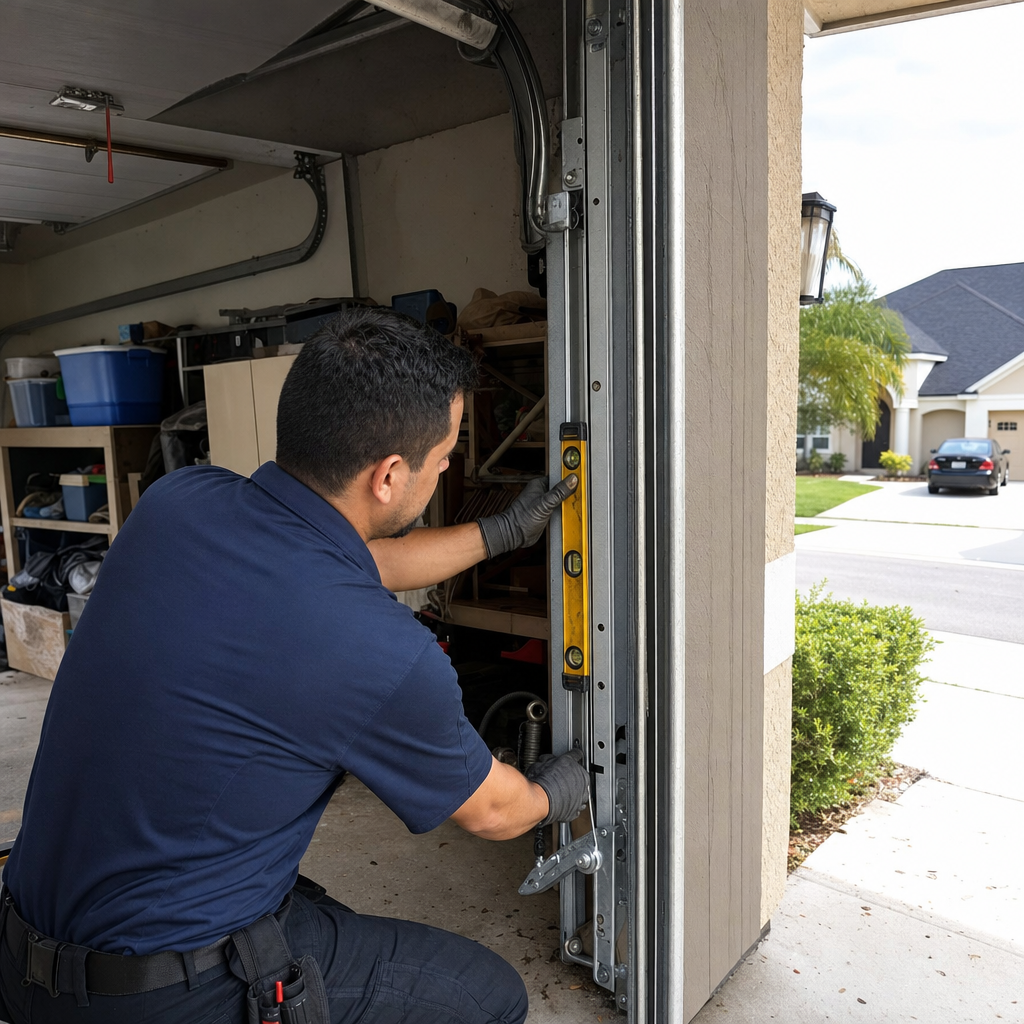
- Track alignment check with level — Orlando’s sandy soils shift concrete slabs
- Opener rail and chain/belt tension adjustment
- Hardware torque check to manufacturer spec with calibrated wrench
- Written condition report with photo documentation
In our 14 years, we’ve found that Orlando doors on preventive maintenance at 10-month intervals average 40% longer spring life and 60% fewer emergency calls than doors on annual tune-ups. The difference is catching corrosion before it becomes failure.
Red flag: Any service in Orlando that doesn’t mention seal condition and humidity-specific hardware inspection isn’t written for this climate.
How to Read a Garage Door Estimate in Orlando: Line Items, Red Flags, and Fair Pricing
We’ve reviewed competitor estimates with Orlando homeowners who were quoted $3,200 for work we completed for $1,800 — same door, same specs. The difference was usually in how the estimate was structured, not the product quality. Here’s how to read what you’re being sold.
Standard Line Items You Should See
| Item | Typical Orlando Range | Notes |
|---|---|---|
| 16×7 steel door (25-gauge, insulated) | $650–$1,100 | Brand matters — Clopay and Amarr price higher than builder-grade imports |
| Standard torsion spring replacement (pair) | $180–$340 | Includes springs, winding, and balance; Galvanized vs. oil-tempered affects price |
| Cable replacement (pair) | $140–$220 | Stainless steel cables add $40–$60 in coastal Orlando areas |
| Bottom seal replacement | $45–$85 | U-shaped vinyl vs. bulb seal; UV-stable rubber costs more, lasts longer |
| Opener installation (chain drive, ½ HP) | $350–$550 | Chamberlain and Genie mid-grade units fall here |
| Opener installation (belt drive, ¾ HP with battery backup) | $550–$850 | Required for new installs in some Florida jurisdictions post-2017 |
| Full door installation (remove and replace) | $400–$700 | Includes disposal, track alignment, opener reconnection |
| Wind load upgrade (hardware kit) | $200–$400 | Required for code compliance in some Orlando zones |
Optional but Common Add-Ons
- Windows: $80–$150 per insert. Insulated glass worth the upgrade in Orlando for thermal performance.
- Decorative hardware: $40–$120. Purely aesthetic.
- Smart opener module: $80–$150 add-on or integrated. MyQ (Chamberlain) and Aladdin Connect (Genie) are common.
- Extended hardware warranty: $75–$150. We generally don’t push these — manufacturer’s defect shows up in year one, and we stand behind our install work.
Red Flags in Orlando Estimates
- “Spring repair” without specifying spring type or cycle rating. Oil-tempered springs last longer than galvanized in humid climates but cost less. If they won’t specify, they may be marking up cheap springs.
- No mention of wind load compliance on replacement doors. In Orlando, this should be explicit — Florida Product Approval number or Miami-Dade NOA reference.
- Opener quoted without horsepower and drive type. “New opener installed” could mean a ⅓ HP builder-grade unit that struggles with your door.
- Labor as a single line item with no hour estimate. Standard 16×7 replacement is 3–4 hours. If you’re charged for 6+ without explanation, ask why.
- “While we’re here” pressure for unrelated work. Common tactic: “Your rollers are worn” on a 2-year-old door with nylon rollers that have 8-year lifespan. We use actual measurements and show photos.
Fair pricing in Orlando isn’t the lowest bid — it’s the bid that specifies what you’re getting, why it fits your climate, and who’s accountable if something fails. When the owner is the technician, accountability isn’t a policy — it’s personal.
Garage Door Openers in Orlando: Power, Battery Backup, and Hurricane Prep
Opener selection in Orlando has specific considerations that northern guides miss entirely. Hurricane season, power outage frequency, and garage temperature all affect what you should buy and how it should be installed.
Power Sizing: Don’t Undershoot
A ½ HP opener handles most single-car steel doors fine. In Orlando, we see two scenarios where ¾ HP is the right call:
- Insulated double-car doors (16×7 or 16×8) — the extra mass needs consistent torque
- Doors with windows or decorative hardware that add 15–25 lbs of uneven weight
We install Chamberlain and Genie openers across Orlando, and their ¾ HP belt-drive units with DC motors are our default recommendation for double-car doors. The DC motor soft-starts and soft-stops, reducing stress on door components — meaningful in a climate where thermal cycling already accelerates wear.
Battery Backup: Code and Common Sense
Florida Senate Bill 1414 (effective 2017) requires battery backup on new opener installations in certain circumstances, and many Orlando municipalities adopted similar requirements. Beyond code, it’s practical: we’ve had customers in Winter Garden and Ocoee trapped during post-hurricane power outages that lasted 3–5 days. A battery backup opener runs 20–50 cycles on reserve power.
If your current opener lacks battery backup, standalone battery units are available for $150–$250 installed. We generally recommend replacing the opener if it’s over 8 years old rather than retrofitting — the integrated units have better charge management.
Hurricane Prep: Disengage and Secure
When a named storm approaches, Orlando homeowners should:
- Disengage the opener and operate the door manually to verify it moves freely — storm debris can jam a door that then fights the opener motor.
- Close and lock the door with the manual slide bolt if your door has one, or add a hurricane brace for non-wind-rated doors.
- Unplug the opener to protect against power surge when grid power returns erratically.
After the storm, check opener operation before re-engaging automatic use — we’ve replaced openers in Azalea Park and Engelwood Park that burned out trying to lift storm-damaged doors with bent tracks.
Common Mistakes to Avoid
- Ignoring the bottom seal until water enters. In Orlando’s afternoon thunderstorms, a cracked seal channels water directly onto your garage floor. We’ve seen mold damage in garages near Lake Underhill and Lake Ivanhoe that started with a $45 seal that went unreplaced for two years.
- WD-40 on garage door parts. It’s a solvent, not a lubricant. It strips existing grease and attracts Central Florida’s fine grit dust. Use silicone spray or white lithium grease only.
- DIY spring replacement. Torsion springs store lethal energy — 200+ ft-lbs on a standard residential door. We’ve responded to emergency calls in Parramore and Holden Heights where homeowners attempted this and damaged the door, the wall, or themselves. This is trained-professional work, period.
- Buying a door online for self-install. The “savings” evaporate when the track doesn’t fit your header height, the spring isn’t wound for your door weight, or the wind load rating doesn’t meet Orlando code. We fix 3–4 of these per year.
- Skipping the wind load sticker check on replacement. We replaced a door in Conway where the homeowner’s insurance inspection happened six months after install. The original installer used a non-Florida-approved door. The homeowner paid twice.
- Assuming all steel doors are equal. 27-gauge steel with no backing costs $200 less than 25-gauge with polyurethane — and will dent, flex, and thermal-bow within three Orlando summers. The cheaper door is more expensive.
- Neglecting opener force settings after door work. New springs change door weight. If your opener’s force settings aren’t recalibrated, the safety reverse may not function. We test this on every spring replacement.
When to Call a Professional
Some garage door issues are maintenance items you can handle — lubricating hinges, clearing photo-eye obstructions, testing the manual release. Others require trained assessment:
- Door hangs crooked or binds in the track — indicates cable, spring, or structural issue
- Loud popping or snapping sounds from the torsion tube — spring failure imminent
- Opener runs but door doesn’t move — stripped gear or broken coupler
- Visible gap in torsion spring — complete failure, door is dangerous to operate
- Post-storm damage to track, panels, or hardware — hidden stress fractures common
- Any door installed before 2002 when insurance renewal or sale is pending — wind load verification needed
Vanguard Garage Door Service Orlando offers free estimates in Orlando — call (833) 789-4392. Robert Garcia personally assesses each job, and we carry stock for same-day repair on most Chamberlain, Genie, Clopay, and Amarr systems. Fast response, real answers.
Frequently Asked Questions
Most residential repairs in Orlando range from $140 for cable replacement to $340 for a standard torsion spring pair, with full door replacements starting around $1,400 for code-compliant 16×7 steel with installation. Emergency same-day service typically adds $50–$75. Call (833) 789-4392 for an exact quote — estimates are free.
Yes, for most common failures — broken springs, snapped cables, off-track doors, and failed openers. We stock springs, cables, rollers, and hardware for the eight major brands we service, including Chamberlain and Genie openers and Clopay and Amarr door systems. Same-day availability depends on parts match and your Orlando location; we cover from Winter Garden to Oviedo and south to Kissimmee.
Repair is cheaper if the door is under 12 years old, the panels aren’t structurally damaged, and the hardware is standard size. Replacement becomes the better value when: the door is pre-2002 and non-wind-load-compliant, multiple panels are dented or rusted through, or repair costs exceed 50% of replacement. We assess both options honestly — 14 years, one standard.
Every 10 months, not annually. Orlando’s humidity and UV exposure accelerate wear beyond national recommendations. A proper preventive maintenance visit includes spring tension measurement, cable drum corrosion check, seal replacement if UV-damaged, and track alignment verification — not just lubrication. This schedule has reduced our customers’ emergency call rate by 60% compared to annual service.
If your home was built after 2002, your door should already comply with Florida Building Code wind load requirements of 120–150 mph depending on zone. If your home is older or you’re replacing a door, yes — wind-rated installation is required for code compliance and increasingly checked by insurers. Look for the Florida Product Approval or Miami-Dade NOA sticker on the door interior.
25-gauge steel with polyurethane insulation and composite or vinyl backing. It resists denting, doesn’t absorb moisture like wood, and the insulated backing prevents condensation that leads to interior rust. Full-view aluminum and glass can work but require marine-grade sealant and budget for glass unit replacement at 5–7 years. Wood doors need resealing every 18–24 months in Orlando — beautiful, but high maintenance.
The Bottom Line
Your garage door in Orlando faces a climate that most national advice ignores: UV that brittles seals in two years, humidity that corrodes hardware from the inside out, and wind load requirements that can affect your insurance coverage. The right door isn’t the prettiest in the showroom — it’s the one specified for Central Florida’s wet season, installed to current code, and maintained on a schedule that catches corrosion before it becomes failure. Whether you’re in Thornton Park, Lake Nona, or Winter Park, the principles are the same: steel gauge matters, wind load stickers matter, and who actually shows up to do the work matters most.
Vanguard Garage Door Service Orlando home is where you’ll find our full service details. For homeowners in the Sky Lake area, we offer dedicated pages for Garage Door Repair in Sky Lake, Garage Door Installation in Sky Lake, and Garage Door Opener in Sky Lake.
Ready to talk through your door? Call (833) 789-4392 for a free estimate. Robert Garcia handles every assessment personally — no call center, no subcontractor roulette, just 14 years of field experience applied to your specific door in your specific Orlando neighborhood.
Written by Robert Garcia, Owner & Lead Technician at Vanguard Garage Door Service Orlando, serving Orlando since 2012.