
Last updated July 8, 2026
Garage Door Emergency Preparedness Guide for Orlando Homes
Here’s a number that stops people cold: the average garage door weighs between 150 and 400 pounds, yet most Orlando homeowners think the electric opener is doing the heavy lifting. It isn’t — the springs are. When a torsion spring snaps at 6:30 AM on a Tuesday in College Park, that door becomes a dead weight that can crush a hand, buckle a panel, or trap your car inside with no warning. After 14 years of emergency calls across Orlando, we’ve learned that the homeowners who fare best aren’t the ones with the newest doors — they’re the ones who knew what to do (and what not to do) before the failure happened. This guide covers both sudden mechanical failures and storm-related emergencies, with protocols specific to Orlando’s climate, building patterns, and hurricane exposure.
Quick Answer
Emergency garage door preparedness for Orlando homes means knowing how to safely disengage an opener when springs have failed, how to temporarily secure a stuck or open door, and how to distinguish between a same-day repair need and a true after-hours emergency. In Orlando’s subtropical climate, rusted springs and wind-load door failures are the two most common emergency scenarios — both require different immediate responses.
Table of Contents
- When Your Garage Door Spring Breaks: The Real Manual Release Protocol
- How to Temporarily Secure an Open or Broken Door
- Orlando Storm Preparation: Hurricane-Rated vs. Standard Doors
- What to Check Before Calling Emergency Service
- How to Evaluate Emergency Service Quotes in Real Time
- The Orlando Maintenance Schedule That Prevents Most Emergencies
- Common Mistakes to Avoid
- When to Call a Professional
- Frequently Asked Questions
- The Bottom Line
When Your Garage Door Spring Breaks: The Real Manual Release Protocol
The red emergency release cord hangs from every garage door opener for a reason — but pulling it at the wrong moment turns a $200 spring repair into a $600+ door replacement. Here’s what changes when a spring fails: your door’s weight shifts from a balanced 8–12 pounds of lift effort to the full dead weight of 150–400 pounds, concentrated unevenly because one spring is doing the work of two (or none, if both torsion springs are broken).
Step-by-step: when the spring is broken and the door is closed
- Do not pull the emergency release yet. The release disengages the opener trolley from the door carriage — it does nothing to reduce door weight. With a broken spring, the door will slam downward or drop unevenly, damaging panels, hinges, or the opener rail.
- Check for a second spring. Torsion systems above the door may have one or two springs. If one is broken and one is intact, the door may still be partially balanced — but unevenly. Extension spring systems (along the horizontal tracks) almost always have paired springs; if one is broken, assume both are compromised.
- Block the door at the bottom. Use a sturdy ladder, 2×4, or your vehicle if positioned safely. This prevents the door from dropping if you must release it.
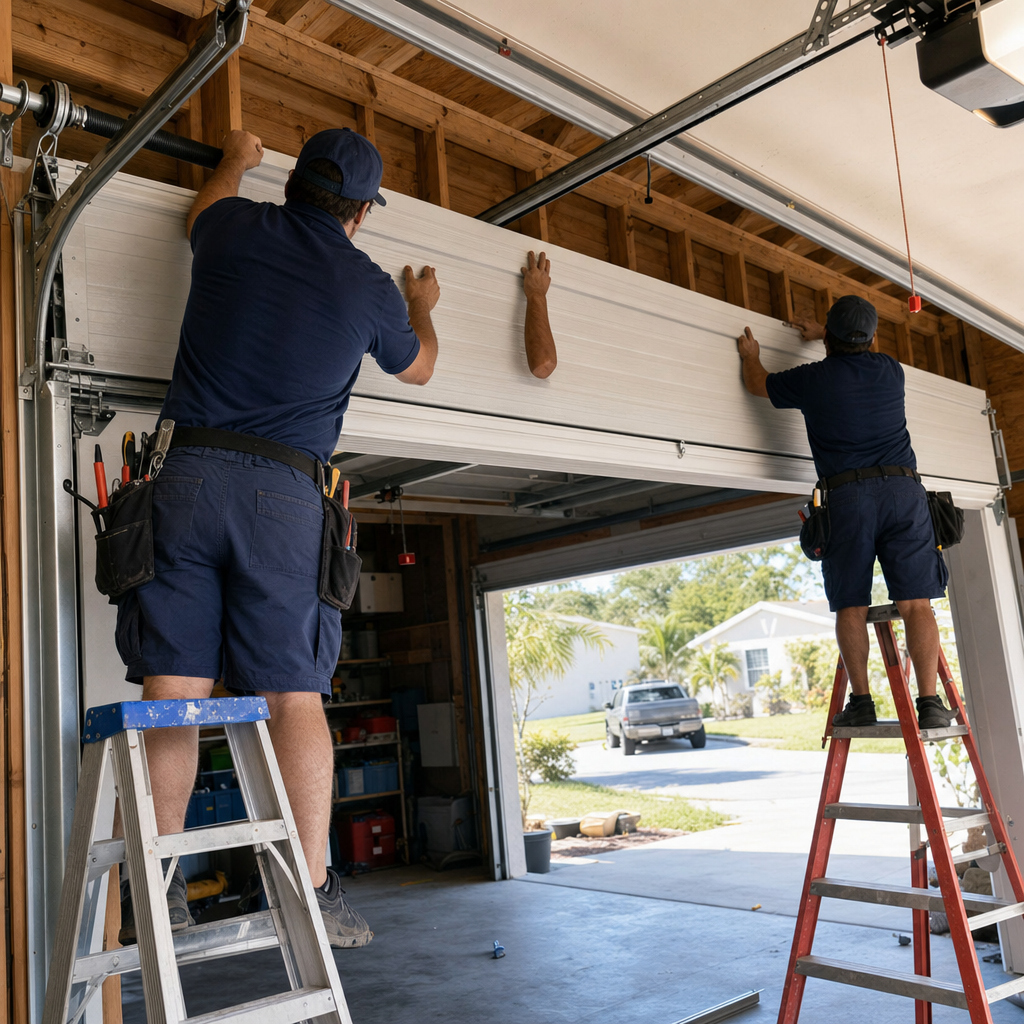
- Pull the release cord only if you have two strong adults and a clear path. Even then, lift from the vertical center of the bottom panel, not the sides. If the door binds, stops, or feels unstable, lower it immediately and block it open or closed.
- If the door is open when the spring breaks, do not attempt to lower it manually. The descent is uncontrolled and dangerous. Block it in place and call for emergency service.
In Orlando’s humidity, we’ve seen spring life expectancy drop 20–30% compared to drier climates. The moisture accelerates rust pitting on uncoated springs, particularly in neighborhoods near Lake Apopka or the Winter Park chain of lakes where morning condensation lingers. A standard 10,000-cycle spring in Orlando often fails at 7,000–8,000 cycles — roughly 5–7 years for a typical family with two cars. We document this with every garage door repair in Sky Lake and surrounding Orlando neighborhoods, because the replacement spring selection should account for local corrosion exposure.
Safety caveat: Garage door torsion springs store massive mechanical energy. Never attempt to wind, unwind, or replace a torsion spring yourself. The winding bars can slip and cause severe injury. This is not a DIY repair.
How to Temporarily Secure an Open or Broken Door
An open garage door is an unsecured garage, and in Orlando’s active residential burglary environment — particularly in areas with alley-access garages like Thornton Park or Delaney Park — a stuck-open door overnight is a genuine security exposure. When you can’t get same-day service, here’s how to secure the opening with materials most homeowners already have.
For a door stuck open (broken spring, derailed, or opener failure):
- Clamp the track. Vice grips or C-clamps on both vertical tracks, just above the bottom roller, prevent the door from rolling down unexpectedly. This is critical — a door with a broken spring can slide down with lethal force if bumped.
- Block the opening at night. Park a vehicle across the garage threshold if space allows. For walk-through security, screw a 2×4 across the interior door frame at waist height — visible from outside, difficult to bypass quickly.
- Disconnect the opener arm. If the opener is still trying to run (grinding, clicking), unplug it to prevent motor burnout and fire risk. The opener isn’t designed to hold a broken-spring door in the open position.
- Cover the interior door. If your garage connects to your house, ensure that door is locked and deadbolted. A garage is easier to breach than a front door; don’t make it a pathway into your home.
For a door stuck closed (spring broken, car trapped inside):
If you absolutely must get a vehicle out and cannot wait for service, the only safe approach is the two-person center-lift method described above, with the door blocked at multiple heights during the lift. We’ve responded to calls in Baldwin Park where a homeowner attempted a solo lift, bent the top section, and turned a $240 spring replacement into a full door replacement plus new opener rail. When the owner is the technician, accountability isn’t a policy — it’s personal — and Robert Garcia has seen this exact scenario dozens of times across Orlando’s established neighborhoods.
Orlando Storm Preparation: Hurricane-Rated vs. Standard Doors
Orlando sits in a unique hurricane exposure zone — not coastal enough for consistent Category 4–5 direct hits, but close enough to the Atlantic and Gulf for regular tropical storm and Category 1–2 impacts. The building code reflects this: garage doors in Orlando must meet Florida Building Code wind-load requirements, but “meets code” and “hurricane-rated” are not the same thing.
Standard doors (pre-2004 or basic replacements): Typically rated for 90–110 mph wind speeds. These rely on the door structure alone and are vulnerable to blow-in or blow-out during pressure fluctuations. If you have a pre-2004 home in Orlando with the original door, you likely have a standard door.
Hurricane-rated doors: Engineered to 140+ mph with reinforced tracks, heavier-gauge steel, and — critically — a wind-load reinforcement system. This may include horizontal struts, vertical posts, or a passive reinforcement system that engages under pressure. Brands like Clopay and Amarr manufacture specific Florida Product Approved models; Wayne Dalton offers reinforced systems for their TorqueMaster line. We verify approval numbers on every garage door installation in Sky Lake and throughout Orlando.
What to do if you have a standard door and a storm is 24 hours out:
- Inspect the door for existing damage. A cracked panel, loose roller, or rusted hinge is a failure point under pressure. Document with photos for insurance.
- Reinforce from the inside if possible. 2×4 bracing in an X-pattern across the interior of the door, anchored to the floor and header, provides meaningful resistance against blow-in. This is not code-compliant permanent reinforcement but is better than nothing for an imminent storm.
- Do not rely on the opener to hold the door. Unplug the opener and manually lock the door if it has a slide bolt. Opener arms are not structural; they will fail under wind load.
- Clear the garage interior. If the door fails, anything against it becomes a projectile. Move vehicles, tools, and stored items to the center of the garage or away from the door plane.
- Know your evacuation trigger. If you’re in a manufactured home, low-lying area, or the storm has intensified beyond your door’s rating, the garage door is not your primary concern — evacuate.
Post-2004 Orlando construction generally includes better garage door wind-load compliance, but we’ve found that builder-grade installations often use the minimum-spec door for cost control. In neighborhoods like Dr. Phillips or MetroWest where large homes got standard-grade doors, a Vanguard Garage Door Service Orlando home assessment can identify whether your door matches your actual wind exposure.
What to Check Before Calling Emergency Service
Emergency garage door service in Orlando runs $180–$450 for same-day response, with after-hours premiums adding 25–50%. Before you pay that premium, confirm you actually need it — and if you do, have the right information ready to get an accurate quote and faster resolution.
Self-diagnosis checklist (2 minutes):
- Is the opener getting power? Check the outlet, breaker, and GFCI. Orlando’s afternoon thunderstorms trip garage GFCIs regularly — this is a free fix.
- Are the safety sensors aligned? The LED indicators on both sensors should be solid, not blinking. Spider webs, leaf debris, or bumped brackets are common in Orlando’s insect-heavy environment.
- Does the door move manually? Disengage the opener (door down, spring presumed intact) and try lifting. Smooth movement means the problem is likely opener-related; binding or heavy weight means spring or track issue.
- Is the door off-track? Look for rollers outside the track channel, bent vertical track, or gap between track and door edge. Do not operate — this will worsen the damage.
Information to gather before calling:
| Door width and height | Measure the opening, not the door itself. Standard sizes: 8×7, 9×7, 16×7, 16×8 feet. |
| Opener model and brand | Located on the motor unit housing. Include model number if legible. |
| Spring type | Torsion: single spring (or pair) mounted horizontally above the door. Extension: paired springs running parallel to the horizontal tracks, often with safety cables through the center. |
| Failure description | Loud bang (spring), grinding (opener gear), door crooked (cable), won’t move (multiple causes). |
| Photo of the problem area | Most Orlando services, including ours, can quote more accurately with a clear photo. |
Having this ready separates a 45-minute diagnostic call from a 20-minute repair. In our experience, homeowners in Orlando’s older neighborhoods like Audubon Park or Colonialtown South often have mixed torsion/extension systems from decades of partial repairs — knowing your actual configuration prevents the technician from arriving unprepared.
How to Evaluate Emergency Service Quotes in Real Time
Orlando’s garage door market includes legitimate owner-operators, established multi-truck companies, and transient operators who appear after storms with rented equipment and no local presence. When you’re stressed and the door is stuck, here’s how to distinguish them.
What a legitimate emergency premium looks like:
- After-hours fee: $75–$150 additional for calls outside 7 AM–6 PM weekdays, or any weekend/holiday call. This covers technician overtime — it’s standard and reasonable.
- Same-day availability fee: $50–$100 for scheduling priority when the schedule is full. Distinct from after-hours; some companies charge both, which is legitimate if disclosed.
- Parts markup: 30–50% over wholesale is standard for inventory, warranty, and vehicle-stocking costs. 100%+ markup is a red flag.
Red flags for price gouging:
- Refusal to quote ranges over the phone. “We need to see it” is valid for complex issues; “we don’t discuss pricing” is not.
- Pressure for immediate cash payment. Legitimate services accept cards, checks, or financing; they don’t demand cash before work begins.
- No local address or verifiable reviews. Check Google Business Profile for review history spanning months or years, not a burst of recent 5-star reviews.
- “Today only” pricing or unnecessary upsells. A broken spring does not require a new opener; a single bent panel does not require full door replacement.
At Vanguard Garage Door Service Orlando, we provide upfront pricing before dispatch for emergency calls — no arrival surprise, no diagnostic fee hidden in the parts. Robert Garcia answers the phone directly for after-hours emergencies, and if he’s on another call, he’ll tell you the realistic response time rather than overpromising. Fast response, real answers.
The Orlando Maintenance Schedule That Prevents Most Emergencies
Emergency preparedness includes prevention. Orlando’s climate creates specific wear patterns that a seasonal maintenance routine addresses before they become 6 AM surprises.
Quarterly (every 3 months):
- Lubricate rollers, hinges, and spring coils with silicone-based spray — not WD-40, which attracts dust. Orlando’s pollen season (February–April) and lovebug season (May, September) accelerate grime buildup.
- Inspect cables for fraying, especially near the bottom bracket where moisture collects.
- Test auto-reverse: place a 2×4 flat on the floor; the door should reverse on contact. Federal law requires this function; a failed sensor is a safety hazard, not just an inconvenience.
Bi-annually (spring and fall):
- Check spring balance: disengage opener and lift manually. Should stay at 3–4 feet open without drifting. Drifting up = over-tension; drifting down = weakening springs.
- Inspect weatherstripping for cracks. Orlando’s UV exposure degrades rubber faster than northern climates; gaps at the bottom admit water during our intense afternoon thunderstorms.
- Tighten all track bolts and roller bracket hardware. Thermal expansion from 50°F winter mornings to 95°F summer afternoons loosens fasteners over time.
Annually:
- Professional inspection of torsion spring system, including cycle count estimation and corrosion assessment. We service your brand — whether it’s Craftsman, LiftMaster, or any of the eight major lines we carry — and can identify whether your springs are appropriately rated for Orlando’s humidity.
- Opener force limit test and travel limit verification. Modern openers have adjustable settings that drift over years of use.
Homeowners who follow this schedule in Orlando typically extend spring life by 30% and eliminate 70% of emergency calls. The 20 minutes per quarter is cheaper than any after-hours premium.
Common Mistakes to Avoid
- Pulling the emergency release with the door open. The door will crash down. Always block or support before releasing, or only release with the door closed and blocked.
- Attempting a solo lift of a broken-spring door. In Lake Nona and Hunter’s Creek, we’ve treated this as a two-person minimum since 2012. The physics don’t change because you’re in a hurry.
- Ignoring a “loud bang” from the garage. That’s a spring breaking. Continuing to operate the opener strains the motor and often strips the main drive gear — turning a spring job into a spring-plus-opener job.
- Using the opener as a lock. Orlando vacation homes are particularly prone to this. The opener trolley provides zero security; always use the manual slide lock when away for extended periods.
- DIY spring replacement from online tutorials. The tools and techniques shown rarely match your specific door geometry. We’ve been called to clean up these attempts in Winter Garden, Ocoee, and throughout Orlando — the “savings” typically cost 3× the original repair.
- Waiting until hurricane season to check door wind rating. Lead times for Florida Product Approved doors extend 4–6 weeks in peak season. Verify your rating in March, not August.
When to Call a Professional
Call for same-day service when: the door is stuck open and cannot be secured, the door is stuck closed with a vehicle or essential equipment inside, a spring or cable is visibly broken or frayed, the door is off-track, or the opener is smoking, sparking, or smells of electrical burning. For after-hours emergencies — a door stuck open overnight, a security-compromised opening, or a door that poses injury risk — emergency garage door service is appropriate.
Vanguard Garage Door Service Orlando offers free estimates in Orlando — call (833) 789-4392. Robert Garcia handles emergency calls directly, and 14 years, one standard means the assessment you get at 10 PM matches the assessment you’d get at 10 AM. We don’t outsource overnight calls to subcontractors who’ve never worked on your brand of door.
Frequently Asked Questions
Emergency garage door repair in Orlando typically ranges from $180 for a simple sensor realignment or cable replacement to $450 for a full torsion spring replacement with after-hours dispatch. The after-hours premium in the Orlando market is generally $75–$150 above standard rates. Call (833) 789-4392 for an exact quote — estimates are free.
You can, but you shouldn’t attempt it alone. A broken spring means the door’s full weight — 150 to 400 pounds — must be lifted manually, and the weight distribution is uneven. Two strong adults lifting from the center of the bottom panel, with the door blocked at multiple points, is the only safe approach. If the door binds or feels unstable, stop immediately and call for service.
Look for a Florida Product Approval number on a label inside the door edge or on the track system. Hurricane-rated doors will specify a wind speed rating (typically 140+ mph for Orlando) and may list a pressure rating in PSF. If your door was installed before 2004 or has no visible approval label, assume it is standard-rated and consult a professional for assessment.
Torsion springs mount horizontally above the door and twist to store energy; they’re standard on modern doors and heavier doors. Extension springs run parallel to the horizontal tracks and stretch to provide lift; they’re common on older or lighter doors. Torsion systems are safer when they fail because they’re contained on a shaft; extension springs can snap free. You can identify your system by visual inspection — look above the door for a horizontal spring (torsion) or along the tracks for paired springs (extension).
Same-day service is typically available within 2–4 hours during business hours in central Orlando neighborhoods. After-hours emergency response varies by provider; at Vanguard Garage Door Service Orlando, Robert Garcia answers emergency calls directly and provides a realistic arrival window based on current location and job status. Call (833) 789-4392 for current availability.
For doors under 15 years old with isolated damage — one broken spring, a single dented panel, or a failed opener — repair is almost always more economical, typically 20–40% of replacement cost. For doors with multiple failed components, significant rust, or pre-2004 construction without wind-load compliance, replacement becomes cost-effective when you factor in energy efficiency, insurance discounts, and eliminated repair cycles. We provide both options with honest assessment — no replacement pressure on repairable doors.
The Bottom Line
Orlando garage door emergencies fall into two categories: the sudden mechanical failure that demands immediate safe response, and the storm scenario that rewards advance preparation. Knowing the manual release protocol, the temporary security options, and the information to gather before calling separates a controlled situation from a costly escalation. For the mechanical failures you can’t prevent, establish a relationship with a local, accountable technician before the crisis — when the owner is the technician, accountability isn’t a policy, it’s personal. For storm preparation, verify your wind rating now, not when the hurricane track narrows. Trusted across 1,000+ jobs, we’ve built our Orlando reputation on showing up with the right parts, the right expertise, and no surprises.
Need an emergency assessment, a wind-rating verification, or a maintenance schedule tailored to your Orlando home? Call (833) 789-4392 for a free estimate. Robert Garcia answers directly for urgent calls, and we service your brand — from Clopay and Amarr to Craftsman and beyond — with 14 years of field-proven expertise.
Written by Robert Garcia, Owner & Lead Technician at Vanguard Garage Door Service Orlando, serving Orlando since 2012.