
Last updated July 8, 2026
Seasonal Garage Door Care for Orlando: Year-Round Homeowner’s Guide
Most seasonal garage door guides waste half their word count on winterizing—scraping ice, weatherstripping for subzero temps, lubricating in freezing conditions. In Orlando, winter is when your door catches its breath. The real damage starts in May, accelerates through hurricane season, and quietly compounds while you’re waiting for a “slow season” that never comes. After 14 years of running calls across Orlando—from Baldwin Park to Dr. Phillips to the condo clusters near Universal—we’ve learned that Orlando’s three real seasons (wet, dry, and hurricane prep) each create distinct, predictable failure patterns. This guide maps exactly what to do, when to do it, and why timing matters for your specific climate.
Quick Answer
Orlando garage doors need maintenance timed to three local seasons: pre-wet season inspection and lubrication in May, hurricane readiness checks in June, post-storm hardware inspection after any tropical event, and structural repairs or repainting during the dry season from December through April. Skip the generic four-season calendar—Orlando’s humidity, UV exposure, and storm cycles create wear patterns that northern guides completely miss.
Table of Contents
- Why Orlando’s Three Seasons Break the Standard Maintenance Calendar
- Pre-Wet Season Checklist: What to Handle Before the Daily Storms Hit
- Hurricane Season Readiness: Wind Ratings, Bracing, and What Actually Works
- Post-Storm Inspection Protocol: Checking What You Can’t See
- Dry Season Repairs: Why December–April Is Your Smartest Window
- Year-Round UV and Heat Management: Protecting Panels from Western Sun
- Common Mistakes to Avoid
- When to Call a Professional
- Frequently Asked Questions
- The Bottom Line
Why Orlando’s Three Seasons Break the Standard Maintenance Calendar
The maintenance calendar sold at big-box stores is built for Cincinnati, not Orlando. Here, we don’t get a gradual spring thaw or a crisp autumn cooldown. We get a switch flip: sometime in late May, the afternoon thunderstorms become daily, reliable, and intense. Humidity climbs from manageable to oppressive. Then hurricane season opens June 1, and every tropical wave in the Atlantic becomes a scheduling variable. By December, the rain pattern breaks, humidity drops, and we enter a five-month window of stable conditions that northern homeowners would call “late spring” year-round.
This climate reality reshapes everything about garage door wear:
- Humidity cycling: Orlando’s relative humidity swings from 50% in dry season afternoons to 90%+ in wet season mornings. Metal hardware—springs, cables, hinges, rollers—experiences accelerated corrosion at the contact points where condensation forms and evaporates repeatedly.
- UV load: Orlando receives roughly 2,400 hours of annual sunshine. A west-facing steel door absorbs concentrated afternoon radiation that can exceed 140°F surface temperature, degrading paint bonds and stressing panel structural integrity.
- Wind exposure: Standard thunderstorm gusts of 40–60 mph test hardware weekly during wet season. Named storms add cyclic loading that fatigues components even when the door appears undamaged.
- Sand and salt: Homes within 15 miles of the coast, including parts of Orlando proper and definitely communities like Sky Lake, see accelerated corrosion from airborne salt particulates carried inland by sea breezes.
We’ve replaced springs in Winter Park that failed at 8,000 cycles—well below their 10,000-cycle rating—because humidity corrosion had pitted the wire surface, creating stress risers. We’ve seen Clopay steel panels in Lake Nona warp from thermal cycling after just four years of unshaded western exposure. These aren’t manufacturing defects; they’re Orlando-specific wear patterns that a generic maintenance schedule won’t catch.
Pre-Wet Season Checklist: What to Handle Before the Daily Storms Hit
Late April through mid-May is your narrow window. Once the Bermuda High settles in and afternoon convection starts firing reliably, you’re playing catch-up. Here’s what we inspect and address on every pre-wet season call in Orlando:
- Bottom seal and weatherstripping: Check for cracking, compression set, or detachment. Orlando’s intense UV hardens rubber compounds faster than northern climates. A compromised bottom seal doesn’t just let water in—it creates a wicking path that keeps the door’s bottom rail damp, accelerating rust on steel doors and delamination on wood composites. We stock seals rated for Florida UV exposure; standard hardware-store replacements often fail within one season.
- Spring and cable inspection: Look for rust bloom, wire fraying, or coil binding. Safety note: Garage door springs are under extreme tension and can cause serious injury or death if mishandled. Visual inspection from a safe distance is appropriate for homeowners; any physical handling or adjustment requires a trained professional. In our experience, springs showing surface rust in May are 60% more likely to fail during wet season’s humidity spikes.
- Roller and hinge lubrication: Use a silicone-based lubricant, not WD-40 (which attracts dust and washes out). Focus on roller bearings and hinge pivot points. In Orlando’s humidity, petroleum-based lubricants emulsify and run, staining the door and leaving metal unprotected.
- Track alignment and debris clearing: Pollen season in Orlando peaks April–May. Combined with oak catkins and the first heavy rains, tracks accumulate organic debris that hardens into a gritty paste. Clean with a dry cloth; avoid water that will accelerate corrosion.
- Opener force settings and safety reverse: Test monthly, but verify specifically before wet season. Humidity affects opener electronics and can alter friction characteristics of the door system. A door that reversed properly in March may fail the test in July.
- Drainage around the door threshold: Orlando’s afternoon storms drop 1–2 inches in 30 minutes. If water pools at your garage entrance, it will find any gap in the seal. Clear gutters, check downspout discharge, and consider a threshold dam if grading slopes toward the door.
We typically book 20–30 pre-wet season tune-ups in the two weeks before Memorial Day. Homeowners who wait until June often face 7–10 day backlogs when the first round of storm damage hits.
Hurricane Season Readiness: Wind Ratings, Bracing, and What Actually Works
Orlando sits inland enough that we’re not in the highest wind zone, but we’re not immune. Hurricane Charley (2004) proved that Category 4 winds can reach deep into Central Florida. More commonly, tropical storms and weaker hurricanes bring sustained 50–70 mph winds with gusts to 90+—enough to test any garage door’s structural limits.
Here’s what actually matters for hurricane season readiness:
Know your door’s wind rating. Check the sticker inside the door or the original documentation. Most pre-2002 doors in Orlando carry no specific wind rating. Post-2002 Florida Building Code requires a minimum design pressure rating, but that doesn’t mean your specific door meets it—many replacements were installed without permits or proper engineering review. A door rated for 20 psf (pounds per square foot) handles roughly 90 mph winds; 30 psf covers approximately 110 mph. Orlando’s code minimum is currently 20 psf, but we recommend 30 psf for peace of mind, especially in open exposure conditions.
Understand manufacturer storm kits. Wayne Dalton and Amarr both offer retrofit bracing kits for certain door models. These are not universal solutions—they’re engineered for specific door widths, heights, and construction types. Installing a storm kit on an incompatible door can create stress concentrations that worsen failure. We’ve removed improperly installed bracing that did more harm than good.
Vertical bracing vs. horizontal reinforcement: Vertical posts anchored to the floor and header (like the old 2×4 “ladder” approach) can prevent inward bowing but do nothing for the door’s own structural integrity. Modern reinforced doors use internal steel struts or upgraded track systems. If your door lacks internal reinforcement, vertical bracing is better than nothing, but it’s a stopgap measure.
The garage door is often your home’s largest opening. Building science research after Hurricane Andrew showed that garage door failure frequently triggers progressive structural collapse—wind enters the garage, pressurizes the interior, and blows out roof structures. This isn’t theoretical; we’ve seen it in post-storm assessments. A failed garage door can convert a survivable storm into a total loss.
Our recommendation for Orlando homeowners: If your door is unrated, pre-2002, or showing any structural fatigue (dented panels, loose track mounting, worn rollers), address it during dry season. Emergency boarding is possible when a storm threatens, but it’s stressful, often incomplete, and no substitute for engineered protection. New garage door installation in Sky Lake and across Orlando should always include a wind-load assessment—we perform these at no charge during estimates.
Post-Storm Inspection Protocol: Checking What You Can’t See
After any tropical system passes—whether it’s a named hurricane or a severe thunderstorm with 60+ mph gusts—your garage door needs specific inspection even if it appears to have survived intact. We’ve learned this from 14 years of post-storm calls where homeowners said “it looks fine” until the door failed completely two weeks later.
Here’s our field-proven post-storm protocol:
- Visual panel inspection: Check for new dents, creases, or paint chips that indicate impact or flexural stress. Steel doors can develop micro-cracks in the paint film that expose bare metal; in Orlando’s humidity, these become rust initiation points within 72 hours.
- Track mounting verification: Inspect where vertical tracks attach to the wall framing. Look for pulled or elongated lag screw holes, separation between track bracket and jamb, or any new gap. Wind pressure can rock the door in its tracks, gradually loosening fasteners that were tight before the storm.
- Spring and cable stress check: Cyclic loading during gusty conditions fatigues torsion springs. A spring that was near its cycle limit before the storm may have crossed into failure territory. Check for increased coil gap (the space between spring coils when the door is closed), which indicates permanent set and reduced lifting force. Do not attempt to measure or adjust spring tension yourself.
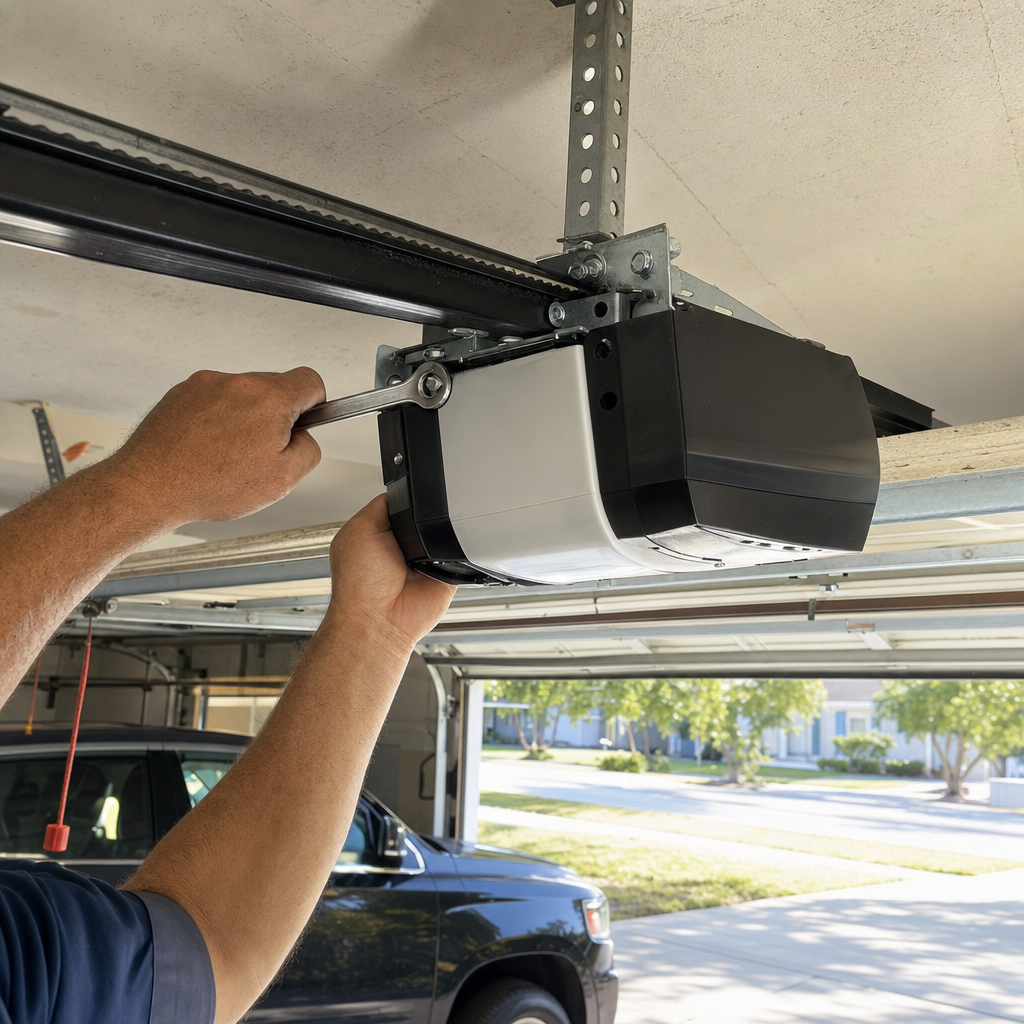
- Opener drive system: Belt-drive openers can develop slack after high-load events. Chain drives may show stretched links. Listen for new grinding, clicking, or straining sounds on the first few post-storm operations.
- Weather seal and threshold: Storm surge and driving rain test seals at pressures far beyond normal use. Check for displacement, tearing, or water staining on the garage floor that indicates seal compromise.
- Manual operation test: Disconnect the opener and lift the door manually. It should move smoothly through its full travel with consistent effort. Any binding, heavy spots, or drift indicates hardware displacement that needs professional correction.
In the Orlando market, we typically see a 40% spike in garage door repair calls 7–14 days after a tropical event—not during the event itself, but as stressed components fail under normal use. Catching these early prevents the door from coming off its tracks or the opener from stripping its drive gear.
Dry Season Repairs: Why December–April Is Your Smartest Window
Orlando’s dry season—roughly December through April—offers the most favorable conditions for major garage door work. Humidity drops to 45–65%, afternoon storms are rare, and temperatures stay in the comfortable 60–80°F range. This matters more than most homeowners realize.
Spring replacement timing: Torsion springs are calibrated to specific door weights and heights. Installing springs in high humidity means the technician is working with metal components that may have surface condensation, and the door’s actual weight can vary slightly as moisture content in wood or composite doors changes. Dry season installation gives the most consistent baseline. More practically, spring replacement in dry season means you’re not scrambling when a wet-season failure leaves your car trapped during a thunderstorm.
Panel repainting and refinishing: Paint curing depends on temperature and humidity. Orlando’s dry season offers the optimal window for factory-quality finish work. We’ve repainted steel doors in January that still looked fresh five years later; rushed touch-ups in July often show brush marks, runs, or poor adhesion within months.
Cable and hardware replacement: Any work involving precise tensioning or alignment benefits from stable conditions. Cables stretch slightly during their initial service period; installing them in dry season lets this settling happen predictably.
Scheduling reality: Our call volume drops 25–30% in January and February. That means faster scheduling, more flexible appointment times, and the ability to book multi-day projects like full door replacement without weather delays. By mid-March, volume starts climbing as proactive homeowners prepare for wet season. By May, we’re booked solid.
Cost considerations: We don’t change our pricing seasonally, but supply chain pressures do. Spring and early summer see increased demand for replacement doors across Florida, which can extend lead times for specific colors or styles. Ordering in February for March installation protects against these bottlenecks.
For homeowners in neighborhoods like Sky Lake or the Conway chain area, dry season is also the best time to address any door work before the summer rental turnover rush, when property managers flood the market with repair requests.
Year-Round UV and Heat Management: Protecting Panels from Western Sun
Orlando’s solar intensity creates a specific, underrecognized failure mode: thermal warping of steel garage door panels. We’ve diagnosed this in homes from College Park to MetroWest, always on west-facing doors, always after 3–5 years of unshaded exposure.
How it happens: Dark-colored steel panels on west-facing doors can reach 140–160°F surface temperature on Orlando summer afternoons. The exterior face expands; the interior face, shaded and cooler, doesn’t. This differential creates bowing stress. Over thousands of thermal cycles, the panel develops permanent set—a slight outward or inward warp that may not affect operation initially but progressively stresses hinges, rollers, and the opener’s lifting geometry.
Structural vs. cosmetic responses:
- Cosmetic: Lighter paint colors, reflective coatings, or applied window film reduce surface temperature 15–30°F. These help but don’t eliminate the thermal stress.
- Structural: Upgraded panel construction—Clopay’s Intellicore or Amarr’s insulated steel designs—uses internal foam core that moderates temperature differential and adds stiffness. For severe exposure, we sometimes recommend aluminum full-view doors or composite materials that handle thermal cycling better than single-skin steel.
- Environmental: Strategic landscaping (deciduous trees that shade in summer, admit light in winter) or a pergola structure can break direct afternoon exposure. In Orlando’s climate, even partial shade helps significantly.
What doesn’t work: Automotive waxes, “ceramic” spray coatings, or other consumer products marketed for heat rejection. We’ve evaluated these; at best they’re temporary, at worst they trap moisture and accelerate corrosion. Factory-applied baked enamel or powder coat remains the most durable finish for Orlando conditions.
When we assess a west-facing door in Orlando, we specifically note exposure hours and recommend accordingly. A door that would serve 20 years on a north face might need structural upgrade in 8–10 years on an unshaded west face. This isn’t upselling; it’s matching the product to the actual operating environment.
Common Mistakes to Avoid
- Treating Orlando like it has a northern winter. Winterizing with heavy grease, threshold heaters, or insulated door blankets is unnecessary and often counterproductive. The grease attracts grit; the insulation traps humidity against metal surfaces.
- Using petroleum-based lubricants year-round. In Orlando’s humidity, these break down and form a sticky residue that collects pollen and dust. Switch to silicone-based products formulated for high-moisture environments.
- Ignoring the door after “it survived the hurricane.” Surviving peak wind doesn’t mean undamaged. Cyclic loading fatigues springs, loosens hardware, and stresses opener drives. The failure often manifests weeks later under normal use.
- Installing storm kits without verifying door compatibility. Manufacturer storm braces are engineered for specific door models. Universal-fit products or improvised 2×4 bracing can concentrate stress and cause the very failure they’re meant to prevent.
- Scheduling major repairs during wet season. Possible, yes. Optimal, no. Wet season repairs face weather delays, higher humidity affecting paint and seal curing, and emergency-call competition that stretches scheduling.
- Neglecting western exposure. Homeowners notice east-facing door fading but miss the structural damage from west-facing thermal cycling. Check west-facing doors specifically for panel warp and paint film cracking.
- DIY spring or cable work. Garage door springs store lethal amounts of energy. Cable replacement requires precise tension balancing. These are not homeowner maintenance items. We’ve responded to injuries that were preventable with a professional service call.
When to Call a Professional
Some maintenance is appropriate for attentive homeowners: visual inspection, lubrication, safety reverse testing, and debris clearing. But certain conditions in Orlando’s climate warrant professional assessment:
Call when you notice uneven door travel, new noises (grinding, popping, squealing), gaps at the bottom or sides, delayed or hesitant opener response, visible spring rust or coil separation, panel dents or warping, or any door behavior change after a storm. Also call before hurricane season if your door’s wind rating is unknown, questionable, or pre-2002.
When the owner is the technician, accountability isn’t a policy—it’s personal. At Vanguard Garage Door Service Orlando, Robert Garcia performs and oversees every job. We bring 14 years of continuous operation and proven expertise across over a thousand doors, including full certification for Genie, Clopay, Amarr, Wayne Dalton, and four additional major brands. Garage door opener service in Sky Lake and throughout Orlando is available with emergency response for urgent situations. Free estimates, upfront pricing, and same-day scheduling when possible—call (833) 789-4392.
Frequently Asked Questions
Professional inspection and tune-up once yearly, ideally in April or May before wet season intensifies. Homeowners should perform monthly visual checks and safety reverse tests year-round. Call (833) 789-4392 to schedule pre-season service—our calendar fills by mid-May.
Spring failure during wet season humidity spikes, followed by bottom seal deterioration from UV exposure and storm debris. In our experience, springs showing surface rust in May fail at 2–3x the normal rate by August. The combination of corrosion initiation and thermal cycling from daily thunderstorms creates premature fatigue.
Manufacturer-engineered storm kits can be homeowner-installed if you precisely match the kit to your door model, width, and height. However, we recommend professional installation because compatibility verification is critical—an incompatible brace concentrates stress and can worsen failure. For doors without specific storm-kit availability, professional structural assessment is the safer path. Call (833) 789-4392 for a free wind-load evaluation.
Direct western sun exposure in Orlando creates thermal cycling stress that degrades paint film and can warp steel panels. Your neighbor’s door experiences roughly 40% less peak solar intensity. Solutions range from lighter paint color (cosmetic) to insulated-panel upgrade (structural) to added shade (environmental). We assess exposure and recommend proportionally.
Yes—for scheduling flexibility, optimal curing conditions for paint and sealants, and avoiding the wet-season emergency-call backlog. January and February typically offer our fastest turnaround. March is still favorable but increasingly competitive. By May, lead times extend and you’re competing with storm-damage urgency calls.
Check for a label or sticker on the interior face of the door, usually in the lower corner, showing design pressure (DP) rating or wind speed. If no label exists, the door likely predates Florida’s wind-rating requirements or was installed without proper documentation. We can assess structural characteristics and recommend appropriate solutions. For Orlando’s exposure, we generally recommend minimum 30 psf design pressure for new installations.
The Bottom Line
Orlando’s garage doors don’t fail randomly—they fail predictably based on humidity exposure, storm cycling, UV degradation, and thermal stress. The homeowners who stay ahead of these patterns schedule pre-wet season maintenance in May, verify hurricane readiness in June, inspect after every significant storm, and batch major repairs during the dry-season window. Generic four-season advice wastes your time; climate-specific timing protects your door’s function, your home’s security, and your schedule. 14 years, one standard: we service your brand, we know your climate, and we show up when we say we will.
Written by Robert Garcia, Owner & Lead Technician at Vanguard Garage Door Service Orlando, serving Orlando since 2012.